
Quick answer
What this means in practice
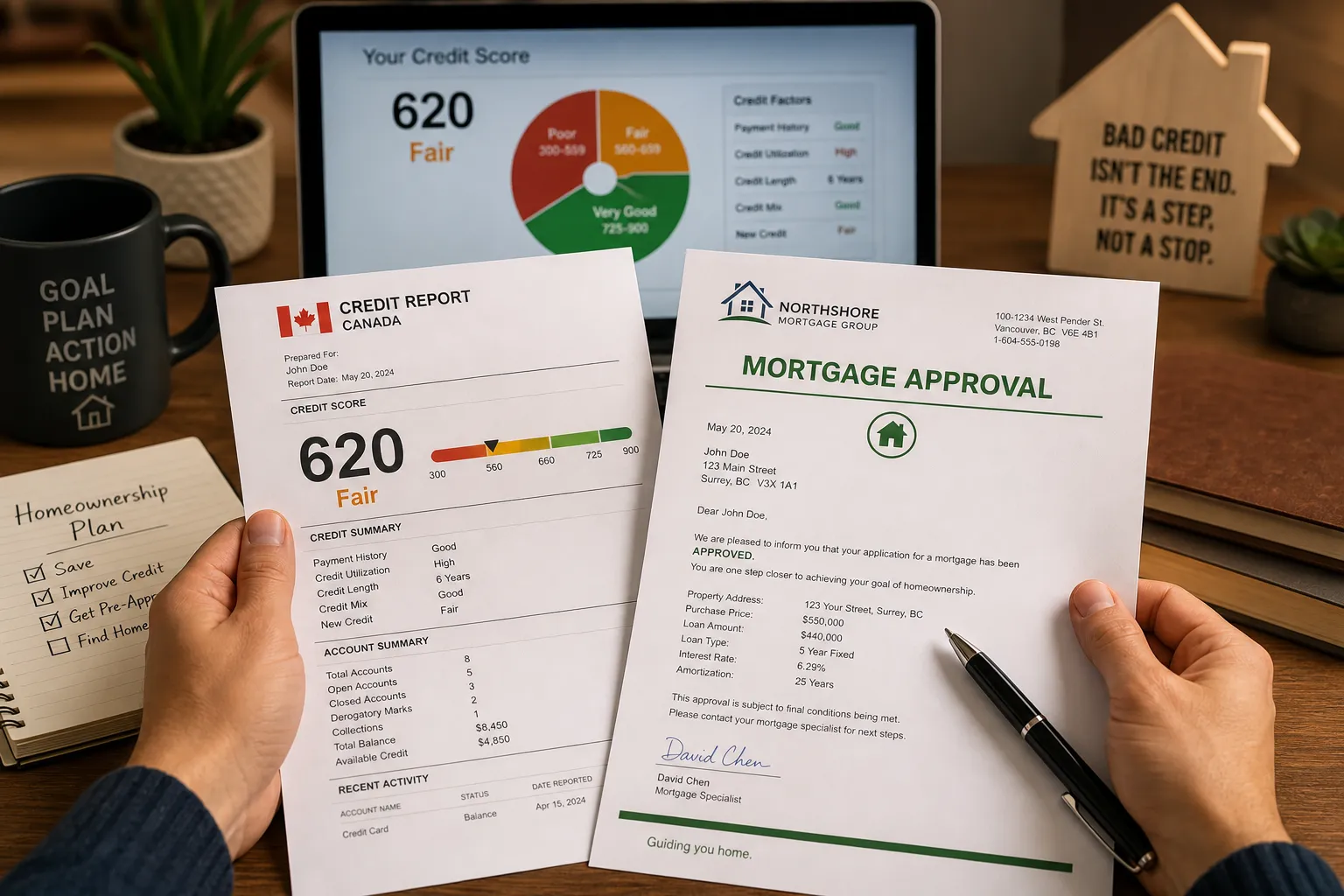
Bad credit and self-employed income do not automatically prevent mortgage approval in Ontario. They do change the order of operations. The file has to explain both repayment risk and income support in a way the lender can defend.
Key takeaways
- Bruised credit and self-employed income can both be workable, but together they require a cleaner explanation.
- The right path depends on the credit event, income evidence, property type, equity, and timing.
- Private lending should usually be treated as bridge financing with a defined exit.
- A rushed second application can make the file weaker if the first decline reason is not understood.
For Muskoka and Bracebridge borrowers, the answer may be a prime lender, a B-lender, a credit union, or a private mortgage. The right option depends on what actually caused the issue: recent late payments, collections, consumer proposal history, thin income reporting, tax arrears, high utilization, property type, or insufficient equity.
Start with the reason the file is hard
A credit score by itself is not enough to choose a lender. A 620 score from high credit-card utilization is different from a 620 score with recent mortgage arrears. A discharged consumer proposal is different from an active proposal. A paid collection is different from a judgment that must be settled before closing.
The same applies to income. Low taxable income, newer self-employment, mixed salary and dividends, cash deposits, and unpaid taxes all create different lender questions.
Prime, B-lender, and private paths
Prime lenders usually offer the best pricing but have tighter income, credit, and debt-ratio rules. B-lenders can be more flexible on credit and self-employed documentation, but rates and fees are usually higher and terms are often shorter. Private lenders are generally equity-focused and more expensive, so they should be used carefully.
A private mortgage can make sense when there is enough equity and a specific short-term problem to solve, such as tax arrears, urgent debt consolidation, or time needed to repair credit. It should not be treated as the default answer for every bruised-credit file.
What strengthens the application
- Recent on-time payment history
- Lower credit-card utilization
- Paid or settled collections where required
- Clear explanation for past credit events
- Filed taxes and a plan for any CRA balance
- Stronger down payment or home equity
- Business bank statements and invoices that support reported income
- A realistic plan to move from alternative lending back to a lower-cost option
Muskoka property factors still matter
Even when the borrower side can be solved, the property has to fit. Lenders may look more closely at rural access, septic, well, waterfront, seasonal use, appraisal comparables, and marketability. A bruised-credit file on a straightforward town property can be very different from the same borrower purchasing a seasonal cottage.
The exit plan
The exit plan is the difference between a strategy and a bandage. A good plan explains what will improve before the next maturity date: credit score, tax filings, income reporting, debt balances, property sale, completed renovation, or transition from private to B-lender or prime financing.
Sequence the lender options by total cost
Start with the lowest-cost realistic option, not the lender with the quickest yes. Compare the contract rate, lender and broker fees, legal and appraisal costs, penalty terms, and the cost of carrying the mortgage until the planned exit. A slightly higher rate with no large fee can cost less than a lower headline rate with substantial upfront charges.
If a B-lender or private mortgage is required, document why the file cannot use a lower-cost path today and what measurable change could open that path later. That keeps the recommendation tied to the borrower's actual timeline.
Evidence to prepare before a second application
- Complete credit reports from both Canadian credit bureaus
- Proof that required collections or arrears were settled
- A short factual explanation of the credit event
- Recent business and personal bank statements
- Filed tax returns and details of any CRA payment arrangement
- Current contracts, invoices, or financial statements
- Proof of down payment or equity and the source of funds